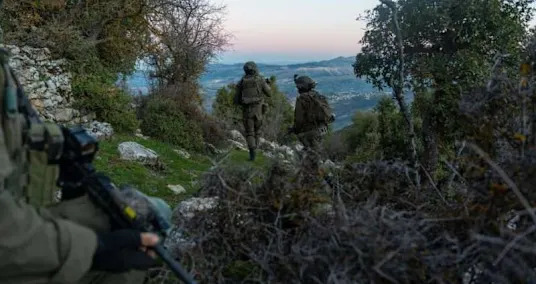
Is Israel prepared to occupy southern Lebanon up to the Litani River on a long-term basis, or is its readiness to hold onto the area a temporary tactic to apply short-term pressure on Hezbollah?
In recent days, top Israeli political officials have largely shifted the goalposts on Israeli policy with regard to southern Lebanon without making clear what the changes fully entail.
In short, is Israel prepared to occupy southern Lebanon up to the Litani River on a long-term basis as it did between 1982-2000 to try to reduce the threat posed by Hezbollah, or is its new readiness to hold onto the area a temporary tactic to apply short-term pressure on the Lebanese terrorist group?
Finance Minister Betzalel Smotrich was the first to speak about the issue in recent days, advocating annexing southern Lebanon – something that is highly doubtful the government would consider.
But on Tuesday, his statement was followed by Defense Minister Israel Katz, who seemed ready to tie seizing southern Lebanon up until the Litani to whether and when Hezbollah would be ready to disarm.
Hezbollah has been dead set against disarming, and there is no obvious way to disarm it without the Lebanese army doing so.

Next, the Lebanese army has shown it remains afraid of the terrorist group, indicating that Katz’s statement, if it reflects policy, could mean holding onto southern Lebanon for years and indefinitely.
Such a position could effectively mean “occupying” southern Lebanon, even if Israel does not formally use the word.
On Wednesday, Prime Minister Benjamin Netanyahu also finally weighed in on the issue.
“We removed the threat of a ground invasion [into Israel from Lebanon] and are further widening the buffer zone,” he said. “We are determined to change the underlying foundations of the situation in Lebanon.”
Netanyahu's statement leaves possibility of extended occupation open
This statement is much vaguer than those by Smotrich or Katz, but the idea of changing the underlying foundations of the situation in Lebanon and of widening the buffer zone leaves open the possibility that Netanyahu might support an extended occupation.
What is the IDF’s professional and apolitical position on the question of occupying southern Lebanon?
First, sources have indicated that the IDF’s position has not remained monolithic but has evolved radically over the past month.
Initially, the IDF hoped that a limited invasion of the first line of southern Lebanon villages, along with increasing airstrikes, would get Hezbollah to stop firing on Israel and get the Lebanese government to act more harshly against the Lebanese terrorist group.
The IDF’s early actions in this war against Hezbollah, while weakening Hezbollah in a broad sense, failed to reduce its rocket fire on Israel at all. In fact, they even led to some increased rocket firing efforts by Hezbollah on some days as it tried to deter the IDF.
At the second stage, sources have indicated that the IDF was ready to move toward the second line of southern Lebanon villages to further pressure Hezbollah and push it farther out of range for firing anti-tank missiles and certain rockets.
This has reduced the anti-tank missile threat and has meant that more Hezbollah rockets have fallen short of Israel, landing in Lebanese territory.
But Hezbollah has still managed to shower the northern border villages with rockets, and sometimes it has struck as far as Haifa and the Lower Galilee.
IDF reluctant to take land in Lebanon
Throughout the war until now, the IDF at nearly all levels has been very reluctant to take over large swaths of southern Lebanon and wanted to stay away from the Litani.
Put simply, the IDF has not forgotten the 1982-2000 experience.
It was a bitter time period, when IDF Chief of Staff Lt.-Gen. Eyal Zamir was coming of age as an officer, and some other top IDF high-command officers also served.
They lost hundreds of comrades in arms over the years and fought countless battles only to withdraw in 2000, with it being unclear exactly what had been achieved by occupying foreign territory for so long.
Holding territory to pressure an adversary sounds like a rational strategy at first.
But tactically holding large areas on a stagnant basis can expose one’s forces to higher chances of being ambushed than in a short invasion in which the ground forces continue to maneuver.
Strategically, Israel will likely be hammered in the diplomatic sphere if it occupies southern Lebanon for any significant length of time.
There was tremendous pressure on Israel to withdraw in the fall of 2024. At that time, in many ways, Israel had a stronger case for wanting to stay longer than it does now, when we have a friendlier Lebanese government and a weakened Hezbollah.
If Hezbollah agrees to some additional measures of disarmament within three months, or maybe six months, such a policy could work.
But if it does not, the IDF is highly concerned about a long-term occupation.
That being said, sources have indicated that the failure of the Lebanese government to rein in Hezbollah, even though it has been trying harder, has switched the IDF into being ready to roll the dice on this issue at least for some period of time.
The tough issue will be if Hezbollah does not disarm, and IDF soldiers start getting frequently ambushed. In that case, the military may want to withdraw, while the political echelon may want to stay longer, even if it has no plan to avoid losing face.
LATEST POSTS
- 1
 Changing Negative Cash Mentalities: Enabling Your Monetary Excursion
 - 2Well known SUVs With Low Energy Utilization In 2024 vote
- 3When darkness shines: How dark stars could illuminate the early universe
- 4Tatiana Schlossberg, a granddaughter of JFK, is dead at 35 after cancer diagnosis
- 5US FDA panel to weigh bid to market nicotine pouches as lower-risk than cigarettes


- A definitive Manual for Choosing Indoor Plants Ideal for Your Space
- 23 Most Amusing Messages At any point Sent Among Youngsters and Their Folks
- Flu season is underway. What are common symptoms to watch for?
- Transform the daily grind to make life more interesting – a philosopher shares 3 strategies to help you attain the good life
- Europe pledges over €15bn for clean energy for Africa
- Figure out How to Improve Your Stream Voyage with Remarkable Trips and Exercises
- I visited the largest collection of public telescopes in the US in Oregon's high desert, and the dark skies blew me away
- Miley Cyrus flashes a diamond ring on the red carpet, sparking engagement rumors with Maxx Morando: A timeline of their four-year relationship
- Tremendous Spelunking: Cool Caverns All over the Planet


